How to find your Moon sign without a birth time
Updated October 12, 2026 · 6 min read · 5 sections
You can find your Moon sign without a birth time more often than most people expect, because the Moon needs about two and a half days to cross a sign. On many birthdays the answer is the same at every hour; on the others you only need to know which side of one specific moment you were born.
I would not guess, and I would not accept a calculator that quietly assumes noon. Noon is right when the Moon holds one sign all day and can be wrong when it does not. Here is how to tell which kind of day you have, and what to do about it.
Why the Moon sign usually survives a missing time
The Moon moves roughly 13 degrees a day, about half a degree an hour, and a sign is 30 degrees wide. So it changes sign every 2 to 2.5 days (Cafe Astrology makes the same point). Spread across the calendar, that gives two kinds of birthday:
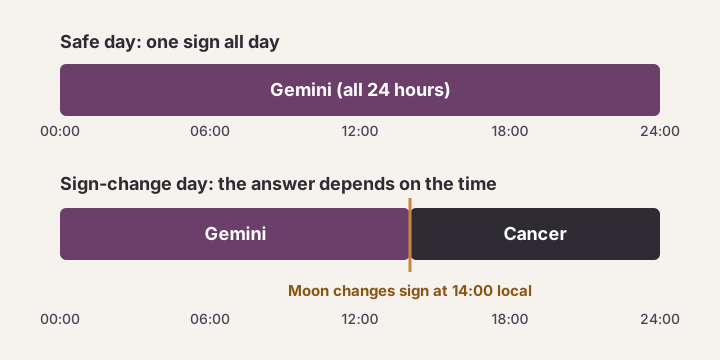
- Safe day. The Moon stays in one sign from local midnight to local midnight. Your Moon sign is certain, time or no time.
- Change day. The Moon crosses into the next sign at some hour of that day. Two signs are possible, and the birth time decides.
The Moon covers about 13 degrees of a 30-degree sign per day, so a change falls on roughly four days in ten. That leaves a bit more than half of all birthdays safe. It is rough arithmetic, not a table, which is why you should check your own date instead of relying on the average.
Step by step: check your date
- Write down the date and the birthplace. City and country are enough; the place sets the time zone.
- Run the Moon sign calculator with "I don't know my birth time" ticked. It checks the whole local day, not the UTC day.
- If the Moon stays in one sign, you are done. Use that sign. It is as certain as one calculated with a full birth time.
- If the sign changes that day, note the change time. The calculator gives it to the minute in local clock time of the birthplace and draws a 24-hour bar, so you can see which part of the day belongs to which sign.
- Ask which side of that moment you were born. Often "morning or evening" is enough. The sections below cover how to find out.
- If you still cannot tell, keep both signs and read both (the calculator shows a reading for each; see Moon sign meanings) until better evidence turns up.
How to narrow it down when the day is not safe
Documents first
A birth certificate is the obvious source, but not every country or era recorded the time. Hospital or maternity records often did, and so do some baptism and church records. You can usually request your own record from the hospital or its archive; the rules differ by place, so ask what proof they need. A baby book or a parent's note made at the time beats anyone's memory.
Family memory, used carefully
Do not ask "what time were you born?" and accept the first answer. People round, and they remember the wrong hour in the right ballpark. Ask anchoring questions instead: Was it light or dark? Before or after lunch? Was your father at work? Who was at the house? You are looking for a window of a few hours, and you only need to land on the correct side of one line. If two relatives agree on "late evening", that is genuinely useful.
Rectification by temperament: be honest about it
Some astrologers rectify a chart by comparing the personality to the candidate signs. For a Moon sign split across two options, I treat this as a tiebreaker only. Moon descriptions are broad, and everyone can recognise themselves in two of them, so the method easily confirms whatever you already half-believe. If one reading fits your private reactions under stress far better than the other, note it as a hunch, not a fact. Real rectification works from dated life events and a full chart, and even then the result is an estimate.
Time zone and daylight saving pitfalls
These cause more wrong Moon signs than a missing birth time does.
- Checking the UTC day instead of the local day. A local day converted to UTC spans two UTC dates. The "does the sign change today?" question has to be asked about the local day you were born into.
- Ignoring daylight saving. A birth at 15:00 in summer time is an hour earlier in UTC than the same clock time in winter time, and the offset rules differ by place and by year of birth. An IANA zone name (such as Europe/Berlin) carries that history; a fixed offset does not (MDN). The calculator shows the UTC offset it used for your date, so you can check it.
- Births on a clock-change night. When clocks move forward, some clock times never existed; when they move back, some happen twice. The calculator warns about both and tells you which offset it used.
- Using today's time zone for an old birth. Countries have moved zones, so the zone where you were born then may not match the one you would pick now.
- Mixing up the birthplace and where you live. The clock on the certificate belongs to the birthplace.
- Midnight births. 00:10 and 23:50 are on different dates. Check how the record writes midnight before you enter the date.
That is why I treat any birth time within about 30 minutes of a sign change as uncertain, whatever the certificate says. Records can be rounded, and clocks were not always set exactly. The calculator flags the same 30-minute window when you enter a time.
What I would do in your position
Run the date first. If it is a safe day, stop worrying: the missing time costs you nothing for the Moon sign. If it is a change day, spend your effort on the record, not on reading personality. One phone call to a hospital archive is worth more than any amount of reading about two signs. Note that a missing time does affect your rising sign, which needs the exact time and place; see Sun, Moon and rising signs explained.
Common questions
Can I find my Moon sign with only my birth date?
Often yes. If the Moon stays in one sign for the whole local day of your birth, the date alone is enough. If it changes sign that day, you need to know which side of the change you were born.
Does the Moon change signs on my birthday?
It does on roughly four days in ten, since it moves about 13 degrees a day through a 30-degree sign. Run your date with the unknown-time option to see whether yours is one of them.
Is noon a good guess for an unknown birth time?
Only on a safe day, where every hour gives the same sign. On a change day noon can give the wrong sign, so look at both possibilities instead.
How much does a one-hour time zone error matter?
The Moon moves about half a degree in an hour, so near a sign boundary a one-hour error, such as a missed daylight saving shift, can flip the sign.